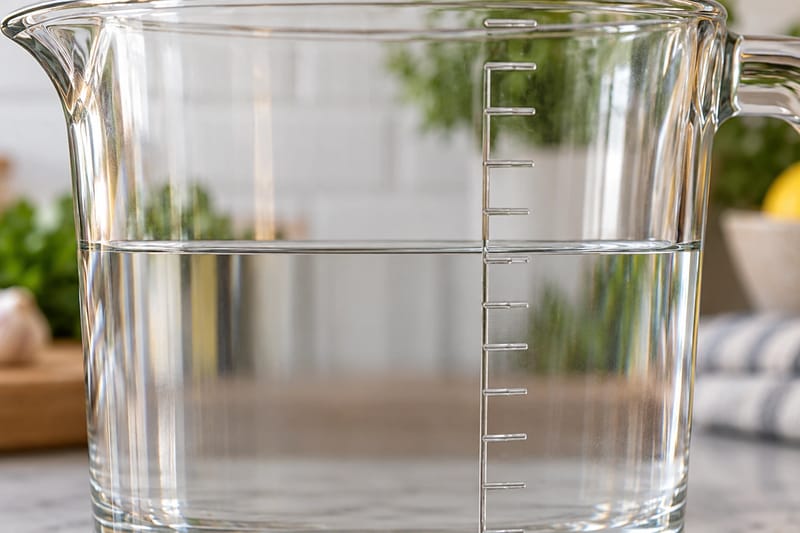
A marked jug gives liquid room to settle below a pouring spout. Read its scale on a level surface, rather than holding it in the air or looking down from above. Check the unit marks before filling, since one jug may show several different systems.
Step by step
Choose a suitable size and unit scale
Use a measuring jug close enough to the quantity that its marks are useful. Select millilitres or the recipe’s cup scale and check the cup convention. For a very small quantity, use a proper measuring spoon instead.
Fill on a level surface
Place the jug flat and pour slowly as you approach the mark. Let bubbles or foam settle where possible. Do not judge the amount while tilting the jug towards you.
Read at eye level
Lower your eyes to the liquid level and compare it with the mark. For a clear liquid with a curved surface, read the bottom of the curve. Add or remove a little liquid until it reaches the required amount.
Transfer the measured amount
Pour into the mixing bowl or pan and allow the jug to drain appropriately. For spoon measures, hold the spoon level and fill without a rounded mound above the rim.
Foam, thick liquids and scale settings
A foamy or very thick ingredient is harder to read in a jug. If the recipe supplies a weight, weighing may be easier. Do not assume the scales’ millilitre setting works for oil, syrup and cream alike; it may use a water-based conversion. Ordinary eating spoons are not reliable measuring spoons.