
Poaching cooks an egg out of its shell in gently moving water. A calm pan helps the white gather around the yolk instead of breaking into strands. For the safest result with ordinary shell eggs, cook until both white and yolk are firm.
Step by step
Prepare the pan and egg
Heat enough water in a saucepan to cover the egg comfortably. Crack a fresh, undamaged egg into a small cup so you can remove shell fragments before it reaches the pan. Have a slotted spoon and serving plate ready.
Reduce the water to a gentle movement
Once hot, lower the heat so the water barely trembles rather than rolling vigorously. Add a little vinegar only if the recipe calls for it; it is not a substitute for cooking the egg safely.
Slide the egg in close to the surface
Bring the cup near the water and tip the egg in gently. Leave space around it. A vigorous whirlpool is unnecessary and can pull the white apart when cooking several eggs.
Cook and lift out carefully
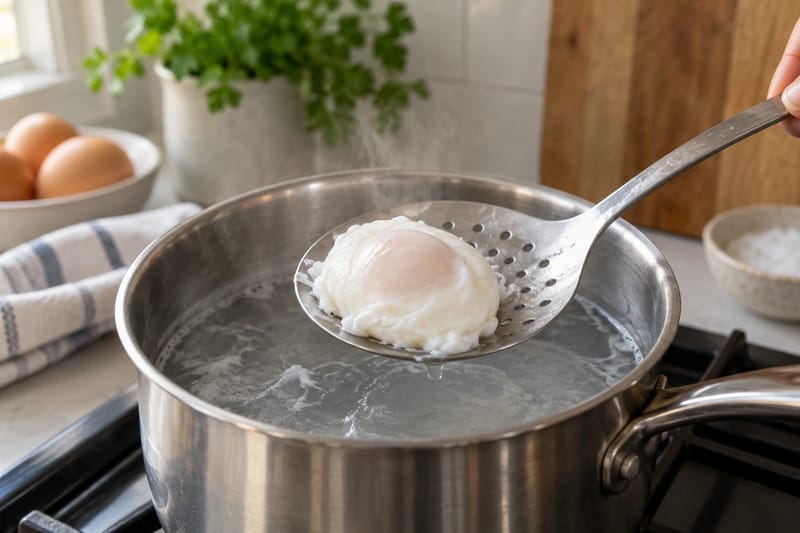
Keep the heat gentle until the white is fully set and continue until the yolk is firm for the safest result. Lift with a slotted spoon, let water drain away and serve promptly.
If you want a soft yolk
Use eggs labelled pasteurised for dishes served with an undercooked yolk. A set-looking white does not establish that an ordinary egg is free of harmful bacteria. Choose fully cooked eggs for people at higher risk of foodborne illness. Times vary with egg size, starting temperature and water temperature.
Loose white strands
Fresher eggs usually hold together more neatly. Lower the egg close to the water and keep the heat gentle. Small wisps are normal; they do not mean the egg must be stirred or chased around the pan.
