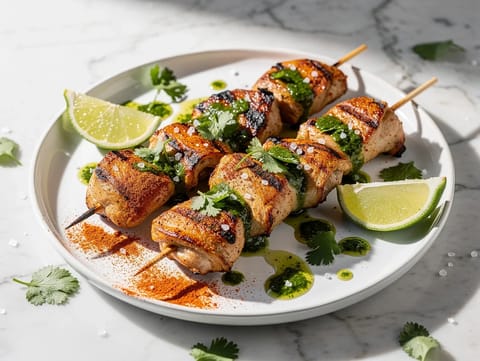
Check chicken with a food thermometer: the safe minimum endpoint used here is 74°C (165°F). Brown skin, pale meat and clear juices do not reliably establish that the centre has reached a safe temperature.
Step by step
Find the thickest part
For a breast or thigh, place the thermometer’s sensing area in the thickest part, avoiding bone. For a thin piece, insert the probe from the side if that lets the sensing area reach the centre. Follow your thermometer’s instructions for sensing depth.
 Image by JustRecipes
Wait for the reading to settle
Keep the probe positioned while the display responds. Check more than one spot and more than one piece when cooking a batch. A reading taken against the pan or bone can mislead you.
Check a whole bird in several places
For a whole chicken, check the thickest breast and the innermost thigh and wing areas, without touching bone. If the bird is stuffed, the centre of the stuffing must also reach 74°C (165°F).
Continue cooking if a check is too low
If any required check is below 74°C (165°F), continue cooking and check again. Do not average a low reading with a higher one. Clean the probe according to its instructions between checks and after use.
A safe endpoint does not mean every cut has the same texture
Some preparations cook chicken beyond the minimum for their desired texture. Keep a recipe’s texture goal separate from the safety check. Cooking time varies with thickness, starting temperature and equipment; a timer cannot replace the thermometer.